Thursday, 29 October 2015

Final Assignment: Changing Attitudes

Final Assignment:


As I do not have a background in Architecture or any real property related discipline, I wanted to look at how people's attitude, actions and behaviour can influence the sustainability of the building.


Here is my exec summary, which is a sum up of the Assignment.


Green Office Culture: Changing Attitudes is a best practice guide that can be used for any office building, but for arguments sake it will be for 60 Miller Street in North Sydney. The guide will stimulate change in regards to sustainable behaviours, actions and attitudes for office workers.


It is based off the highly successful Singaporean Project Eco-Office and Harvard’s Green Office initiative, both of which used motivational posters, wide-reaching information services and the creation of a ‘green culture’ to influence worker behavior in office buildings.


Through a number of case studies and research, it is clear that human behavior can have a significant impact on the overall sustainability of a building. Therefore Changing Attitudes will target office worker behavior and attitudes to initiate change and make offices greener and more sustainable.


Changing Attitudes will be a best practice guide for office behavior, in conjunction with a consultant who will analyse the current office set up and advise on future changes and provide a number of benchmarks. 


It doesn’t matter how ‘Green’, efficient or sustainable a building is, the biggest concern is who occupies the building and what they are doing inside.

Reflection
I think I merely scratched the surface of this topic. If I had more time and more words I could have gone into HUGE detail about people's behaviour and how to change it. As such, I feel I didn't do myself justice on the assignment.
however, I have a greater belief that if people can band together and believe in something then it can be changed.


Friday, 23 October 2015

Post-Session Week 12

Pondering some questions by Malay 


  1. What are the energy/emission related impacts of your actions and lifestyle currently? What do they mean to you?
 I live in a terrace house with 3 other guys in Paddington, so I know that my footprint is relatively small. 


Biggest impacts would be:


1. Driving my car on the weekends and to and from Uni
2. Recycling waste
3. Energy usage (we all have multiple laptops, mobile phones etc at home)
4. Flying (only fly a couple of times a year)
5. I get most of my food from Aldi, and god knows how far that has travelled


  1. Which areas are of particular concern to you? Why?
As I said, my car is probably my biggest impact. I use it a lot on weekends and driving to and from various sporting events. It is probably most concerning because there is not a lot I can do to stop using it. Sydney's public transport system is very inadequate and there are some places I just need a car to get too. The biggest concern is how much I rely on it.


  1. What have you already done in response to these energy/emission impacts and your concerns?
I can't say I have done anything to change my reliance on my car. I have improved in that I don't use it during the week, which is a big improvement and I do a lot of bike riding and catch public transport to work.


However, while one day I might consider selling and using other options of transport, in all honesty I can't do that unless public transport improves and ride sharing becomes more popular and cheaper. 


  1. What are you currently working on or would like to do in the future in response to the remaining issues? What is preventing you? How will you overcome them?
Personally I can't do that much for my car woes. But I am going to work for Lend Lease next year. I really respect their desire to add sustainability into their developments. I hope, through a successful career at Lend Lease, that I can improve a number of facets of energy and emission in new buildings that will go up around Australia. 


  1. What other positive impacts do you see yourself making beyond your immediate personal lifestyle? How? 
  2.   
  3. I feel the above answer answers this question. Hopefully working for Lend Lease, who are very big on sustainability and will continue to ramp up their work in this area, will ensure that I can contribute in other, greater ways than just myself.

Thursday, 22 October 2015

Pre-Session Week 12

Pre-Session Week 12

"Are We Ready for Zero Carbon Buildings?" 

From this article here https://sourceable.net/zero-carbon-buildings-but-are-we-ready/# 
  
In the article, Dr Prasad says that are two main barriers to achieving these zero carbon buildings, economics and attitude.

They are pretty weak barriers, if you ask me. It is disappointing to think that Governments and organisations can't get their priorities sorted to make these affordable changes that will have enormous long term benefits. Prasad says that nearly $17 trillion could be saved if an effort was made for low carbon cities by 2050!!!!!! THAT"S ENORMOUS! Come on Governments, do something.

Sometimes I feel that making those sort of changes comes down to the "they're not doing it, so why should we do it". The feeling that someone making a change is so insignificant that it is not worth doing.


Hopefully that attitude changes.

Added Thoughts: Biomimicry 2.0 Zimbabwe

The Termite Building (Biomimicry in Action) 

Wow, well I stumbled upon this and it is pretty amazing.

Biomimicry uses nature as its motivation, as its perfect example of keeping cool, warming up and surviving.

This has been done with a building in Harare, Zimbabwe.  There have been issues around Zimbabwe in terms of inflation, leadership and poverty. However, this building is a shining beacon of beauty (not so much aesthetically, as you will see, but beautiful in other ways).


Eastgate Centre, Biomimetic Architecture, Biomimicry, Biomimetic Design, Biomimicry of Termite Mounds, Green Building With Termites, Eco Building, Sustainable Design, Harare, Zimbabwe, Africa, sustainable architecture, biomimicry, termite mound, construction, natural cooling, natural ventilation


So apparently, termites in Zimbabwe build gigantic mounds inside of which they farm a fungus that is their primary food source. The fungus must be kept at exactly 28 degrees while the temperatures outside range from 2 degrees to 35 degrees during the day and night. The termites achieve this by constantly opening and closing a series of heating and cooling vents throughout the mound over the course of the day. With a system of carefully adjusted convection currents, air is sucked in at the lower part of the mound, down into enclosures with muddy walls, and up through a channel to the peak of the termite mound. The industrious termites constantly dig new vents and plug up old ones in order to regulate the temperature.

The building used natures own mechanisms to have no heating or cooling system, but instead relies on a series of vents.

Wow. Nature at work.

Added Thoughts: Biomimicry

Biomimicry

Image result for biomimicry


Biomimicry is this very cool concept that 'mimics' nature and its approach to structure and movement to create buildings, transport systems and other things that mimic nature.

It has ramifications for building design and sustainable practice.

We did an really interesting assignment for another sustainability course and we described how biomimicry would work for traffic (in the future, obviously). It would use driver-less cars and would flow like a school of fish, a concept called SWARM.

This is what it is, with so many options!


"Biomimicry is the exploration of the physical forms and intricate networks that are found in natural systems and individual organisms (The Biomimicry Institute, 2014). Biomimicry understands and appreciates that through billions of years, nature has adapted and discovered ways to adapt and become resilient to drastic changes in the physical environment. By utilizing the research that nature has already done, we can move forward with better, sustainable designs"

Planes mimic birds. Submarines mimic whales, dolphins. 

A building in Harare, Zimbabwe has used biomimicry for a completely green building. 

That's for the next blog!

Added Thoughts: 1 Bligh Street, Sydney

1 Bligh Street 

Sydney has some spectacular buildings, but I've been struck by 1 Bligh St.

My friend works in Clayton and Utz who have a number of offices there and I was taken inside to have a look.

Wow.

The air flow, circulation and the open space. Just blew me away.

If more buildings could be designed like that, things would be better! 


Added Thoughts: Smart Cities 2.0 Songdo

Added Thoughts: Songdo and Smart Cities 


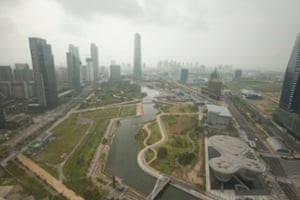
The Smartest City at the moment, and one where smart technology has been put into nearly every possible building, is Songdo.


Songdo has been labelled as the World's Smartest City and the City of the Future.

So what have the South Koreans done and why? 


Songdo International Business District has been built on 1,500 acres of reclaimed land.


Songdo is a city that has been built from scratch on reclaimed land, some 65km away from Seoul. 

It is a private real estate development, and when finished will have 80,000 apartments, 50,000,000 sqm of office space and 10,000,000sqm of retail space. 

It will house around 50,000 as residents, with a further 50,000 commuting to work. 

The project was intended to show the world the technological prowess of Korea and create a sustainable city. It has cost nearly $35 billion and is due to be completed in 2017. 

Tellingly, 40% of the city is slated to be 'parkland', which ties into the sustainability aspect of Songdo. 

As far as Smart Cities go, it is exceptional. 

Songdo has been inundated with sensors, which monitor temperature, energy use and traffic flow. 

These sensors allow you to understand when your bus is due, and provide current updates on the surrounds. 

Other innovations (that are nearly all world firsts for cities) include; 

  • charging stations for electric cars 
  • water recycling systems that uses recycled water to flush toilets 
  • waste disposal system that automatically sorts waste according to its danger to the environment 
  • internal monitoring systems within buildings that provide information on any maintenance or issues 

Personally, I think it is a great idea with fantastic innovation. Putting these innovations into place in other established cities is another challenge in itself.